 NFT marketplace
 compatibility for wallets, networks and token contracts
NFT marketplace compatibility determines whether a wallet can display, list, buy or transfer a token on its actual network. The useful checks happen before a signature: confirm the network, collection contract, token standard, custody model and fees tied to the intended action. A marketplace may support browsing a collection without supporting every wallet, listing method or settlement route associated with it. Identify whether the wallet is asking for a message signature or an on-chain transaction, then inspect any approval or transfer that the request authorizes. Keep the request unsigned until those details match. If they do not, stop without authorizing the action.
Key takeaway: A sound marketplace choice starts with matching the wallet, network, token contract and transaction terms before signing.
Compatibility sets the available path
The usable path begins where the wallet, blockchain network, token contract and marketplace function overlap. Public listings may be viewable without connecting a wallet. Minting, bidding, buying and listing introduce separate requirements because each action can call a different contract or request a different authorization.
Network support alone does not establish token support. A marketplace also needs to recognize the collection contract, interpret its ownership records and handle the relevant token standard. The selected payment asset must work with the settlement route, while the wallet needs enough of the network's fee asset to submit any required on-chain transaction. A mismatch can leave a token visible but unavailable for the intended action.
Wallet control and approval boundaries
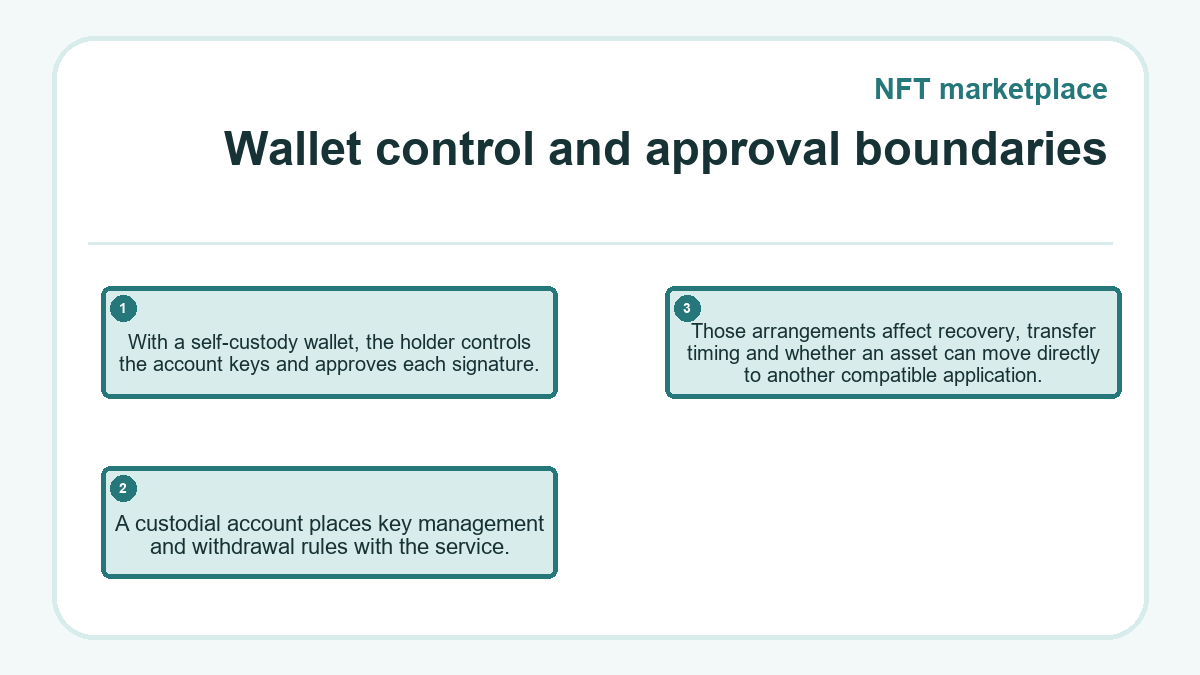
With a self-custody wallet, the holder controls the account keys and approves each signature. A custodial account places key management and withdrawal rules with the service. Those arrangements affect recovery, transfer timing and whether an asset can move directly to another compatible application.
Connecting a wallet exposes its public address to the application, but connection alone does not transfer a token. An approval is different. Depending on the token standard and contract, an approval may cover one token or authorize an operator to handle multiple tokens from that contract. Check the approved operator and scope before confirming it. Revoking an approval can block later use, but it cannot reverse a transfer that has already settled.
What does the transaction actually authorize?
The effect of a request depends on the signed message or contract call and on the code that processes it. A sign-in message can demonstrate control of an address without moving an asset. A listing may use a signed order, while a purchase can invoke a settlement contract that exchanges payment for the token. Some flows also require a separate token approval before settlement.
Readable typed data, decoded calls and wallet simulations can clarify a request when those features are available. Compare the network, contract, operator, token identifier, payment amount and deadline with the action shown on the marketplace. If the contract is unfamiliar or the authorization is broader than the intended action, stop and verify the request before signing. A clear display improves inspection, although it does not prove that the underlying contract is safe.
Cost inputs before settlement
Total cost can include the sale price, a marketplace charge, a creator payment and one or more network fees. The exact combination depends on the listing structure, payment asset and contracts involved. A first approval may require its own transaction. A signed off-chain listing may cost nothing to create but still incur a fee when it settles or is cancelled on-chain.
Network charges vary with the chain's fee mechanism, congestion and computational work requested by the transaction. A rejected wallet request is not submitted and does not consume a network fee. A submitted transaction that fails may still incur a charge because the network processed it. Compare quotes at the same stage of the same action, since minting, approving, buying and transferring do not have identical cost inputs.
Token standards, metadata and collection identity
A token's network, contract address and token identifier form its practical identity. A familiar collection name or image can be copied, so neither is enough to establish that two listings refer to the same asset. Marketplace verification labels may provide a platform-specific signal, but they do not replace inspection of the underlying token record.
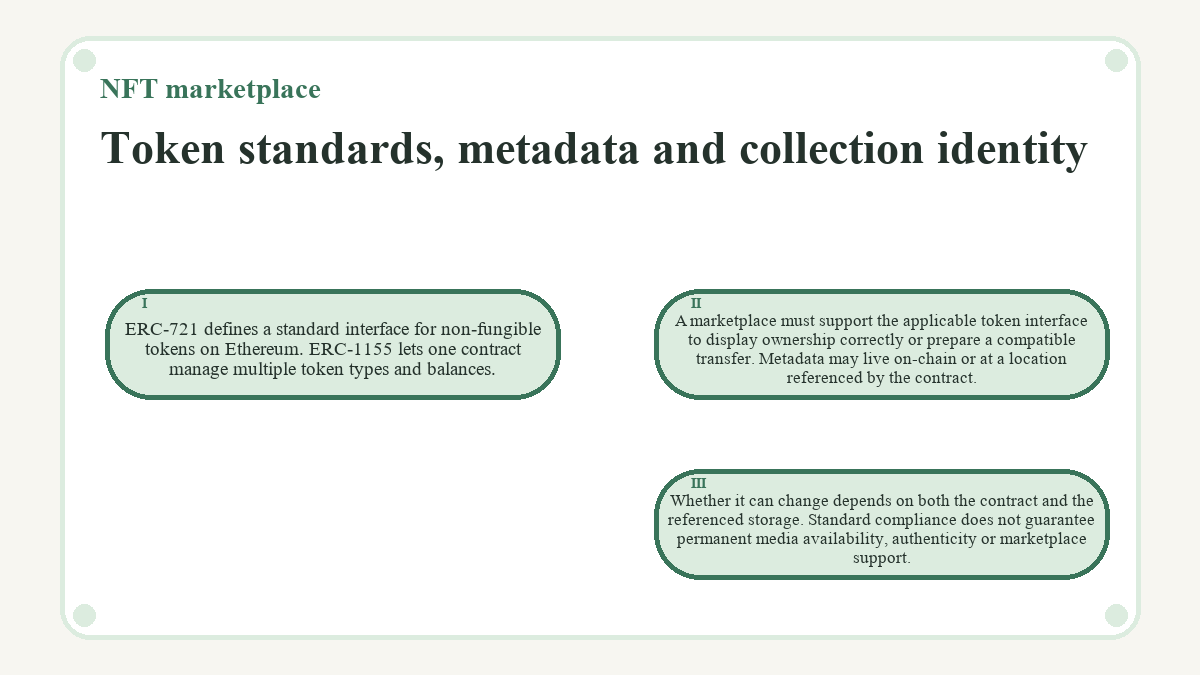
ERC-721 defines a standard interface for non-fungible tokens on Ethereum. ERC-1155 lets one contract manage multiple token types and balances. A marketplace must support the applicable token interface to display ownership correctly or prepare a compatible transfer. Metadata may live on-chain or at a location referenced by the contract. Whether it can change depends on both the contract and the referenced storage. Standard compliance does not guarantee permanent media availability, authenticity or marketplace support.
A reversible pre-commitment check
A reader preparing a purchase keeps the request unsigned while comparing the wallet, network, token record and quote. When those details agree, the reader can proceed to the final authorization check. The artwork and collection name may look familiar even when the contract address differs. If it differs, the reader leaves the request unsigned until confirming the intended collection contract.
- Match the wallet's selected network to the network that records the token.
- Match the collection contract and token identifier to the intended asset.
- Read the request type, contract address and approval scope before signing.
- Confirm that the wallet has enough of the payment asset for the quoted total and enough of the network's fee asset for any displayed approval and settlement charges.
- Keep the transaction hash or order record for the settlement check.
After every checklist item agrees, the reader can approve an on-chain request for signing and submission. Submission is the commitment point for that action. A signed off-chain order instead creates an authorization that another party may execute under its terms. After an on-chain submission, use the transaction record and contract state to check whether settlement completed and ownership changed. If a material detail changes before signing, reject the request and begin again from the intended token record. Rejecting an unsigned request stops that request, while a submitted transaction may no longer be reversible.
Listings, bids and settlement states
A listing can transfer an NFT into escrow or leave it in the owner's wallet under a signed order. A bid may rely on deposited funds, an approved payment token or another contract-specific arrangement. These structures create different custody and cancellation conditions even when their marketplace screens look similar.
Visible orders are not always executable. Ownership may have changed, an approval may have been revoked, a deadline may have passed or the bidder's funds may no longer satisfy the order. Removing an order from a website can hide it without invalidating its signed authorization. Where the order design supports explicit cancellation, that action changes the order's usable state rather than merely changing its display.
Which evidence confirms completion?
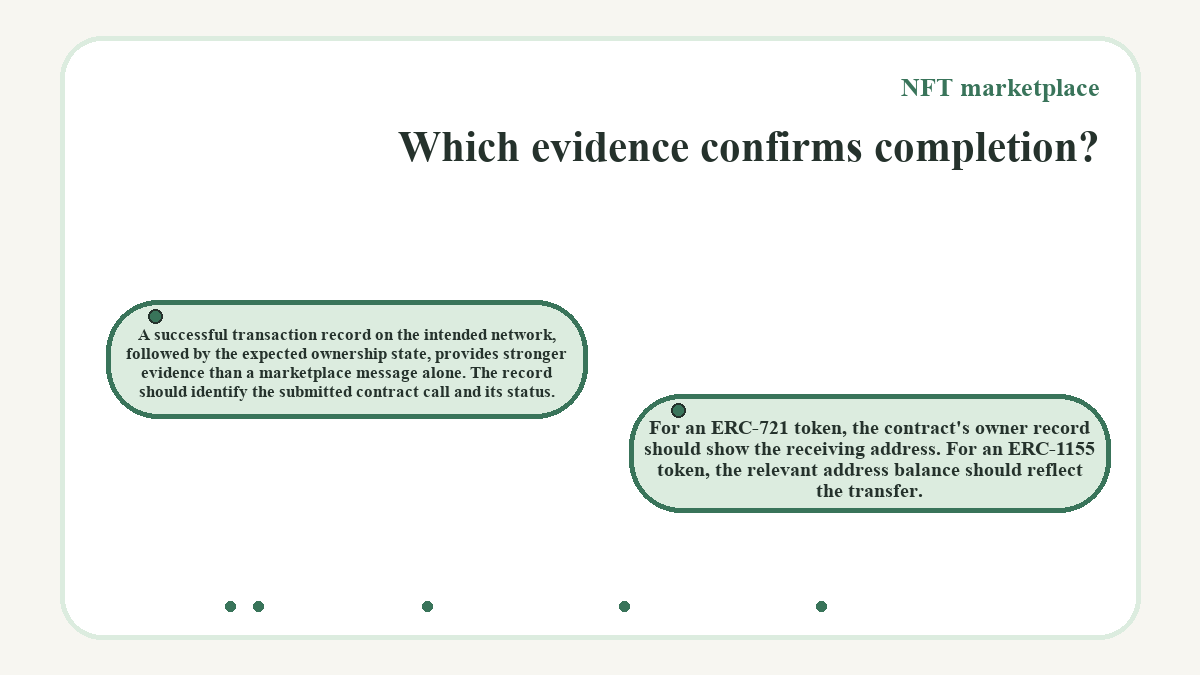
A successful transaction record on the intended network, followed by the expected ownership state, provides stronger evidence than a marketplace message alone. The record should identify the submitted contract call and its status. For an ERC-721 token, the contract's owner record should show the receiving address. For an ERC-1155 token, the relevant address balance should reflect the transfer.
Marketplace displays can lag behind the underlying chain because their indexing systems update separately. A missing thumbnail or stale owner label therefore does not establish that settlement failed. Check the transaction status and token contract state first, then refresh the marketplace record. Network finality varies, so the number of confirmations required for a service to treat a transfer as settled can also vary.
Ownership, licenses and resale terms
Owning an NFT establishes control of the token under its contract rules. It does not automatically transfer copyright, trademark rights or permission to use the associated work commercially. Those rights depend on the applicable license or agreement, which may be separate from the token metadata.
Transfer rules also differ. Some contracts permit ordinary wallet-to-wallet transfers, while others can impose restrictions through their code or surrounding service. Payment distribution, creator compensation and marketplace eligibility are separate questions from token ownership. Compatibility can confirm that a transfer is technically executable, but it cannot supply usage rights that the governing terms do not grant.
What to know about NFT marketplace
Can the same NFT be listed on several marketplaces at once?
The same NFT can have multiple visible listings when marketplaces accept separate signed orders or read a shared on-chain listing. Once one order transfers the token, the others may become unfillable because the seller no longer owns it. Old signed orders can still matter if ownership later returns, so sellers should use the applicable cancellation mechanism instead of relying only on a hidden listing.
Why did an unsolicited NFT appear in my wallet?
A public blockchain address can receive tokens without its holder requesting them. The token's presence does not prove that its linked media, claim page or collection is trustworthy. Avoid following embedded links or signing requests connected to an unknown asset. Hiding the item in a wallet interface changes its display only; it does not erase the token from the blockchain address.
Does changing wallet apps change ownership of my NFTs?
Changing the wallet application does not change blockchain ownership when the new application controls the same address on the same network. The displayed collection can still differ because wallet apps support different networks, token standards and metadata indexes. Never disclose a recovery phrase to an untrusted application merely to restore a missing image; confirm address and network support before importing an account.
Are creator royalties guaranteed on every NFT resale?
Creator royalties are not guaranteed across every resale route. Payment may depend on marketplace policy, settlement-contract logic or transfer restrictions built around a collection. A royalty shown during one sale does not establish that every compatible marketplace will collect it later. Buyers and sellers should distinguish an enforceable contract condition from a fee that a particular marketplace chooses to apply.
When can an NFT sent to the wrong address be recovered?
Recovery depends on who controls the destination and whether it can send the token back. If another person controls the address, only that controller can authorize a return. If the destination is a contract, recovery requires compatible transfer or rescue logic in that contract. Once the transfer settles, recovery still requires control of the receiving account or a recovery function supported by the destination contract; the marketplace interface cannot reverse it on its own.